
Students at Airline Drive Academy were in for a treat when the NY Maple Experience visited earlier this month.
Students and staff were welcomed aboard the NY Maple Experience—an exhibit set inside of a 24-foot trailer— to learn about maple syrup and the tools and apparatuses used to produce it. The presentation was led by Adam Henne, maple syrup educator with the New York State Maple Producers’ Association, followed by a tasting with Dawn Sisson from Bittersweet Maple Farm in Berne, NY.
Discovered by Indigenous tribes hundred of years ago, maple syrup is made by extracting sap from mature maple trees and boiling the sap to evaporate the water and concentrate the sugars, said Henne. He told the students about a folklore from the Anishinaabe about how the current extraction process came to be.
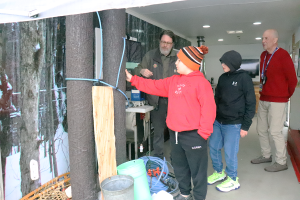
“Their story is that in ancient times, there really was just maple syrup in a maple tree, and anybody could go up and drink syrup out of the tree anytime they wanted,” he said. “The problem was that they liked it too much. People got hooked on it and all they wanted to do was to drink maple syrup out of the tree and forget about everything else.”
The folklore goes that maple trees were once full of syrup and all one had to do to enjoy it was poke a hole in the tree. Until one day the trees were filled with water, which diluted the syrup and created sap. From that point on, anyone who wanted to enjoy maple syrup had to work hard for it by accumulating at least 40 gallons of sap for just one gallon of syrup.
Sixth grader Mya Smith said her favorite part of the exhibit was learning that maple syrup is made “in my own backyard.”
Special Education teachers Rhonda Jensen and Christopher Conti said their students learned a lot from Henne and Sisson.
“I know I sure did,” said Jensen. “The NY Maple Experience was a wonderful opportunity for my students to get a different experience outside of the classroom.”
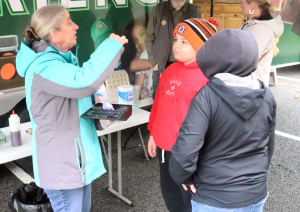
Conti said it was nice for his students to learn about the work that goes into making the foods they enjoy.
“The teachers have some curriculum materials they may be covering beforehand so the kids come out ready to engage and learn,” said Henne.
Teaching Assistant Chuck Fuller said he and his students were especially interested in learning about how maple syrup is graded.
“My students had the chance to use their number comparison skills to figure out if the maple syrup is darker or lighter. Right now we’re comparing numbers and, in real life, I just saw them compare numbers,” he said.
Fuller’s students were visibly intrigued by the color variations of the maple syrup that Sisson brought, which ranged from dark to golden brown. Sisson explained to them that the colors depend on how soon the sap is collected from the maple trees and how long the sap is boiled.
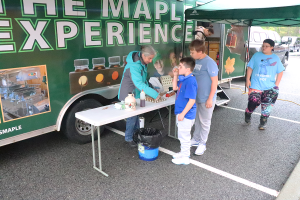
“As you’re boiling, the Maillard process is happening,” she said. “That’s the same thing that makes your toast turn brown, or if you cook a steak and get a nice sear on the steak—it’s the same process. As the sugars cook and caramelize, they get darker and take on a stronger flavor.”
Sisson said she hopes students take away an interest in learning more about real food, making real food and connecting with nature. “That’s one of the best things about being able to share this [experience]; is to get people to reconnect with natural made products and how it happens.”