
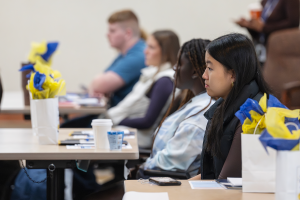
Student Board of Education members from the Capital Region and beyond met for the second annual Student Board of Education training on Sept. 30. The training took place at the New York State School Boards Association (NYSSBA) and was live streamed to all 36 BOCES and school districts across the state.
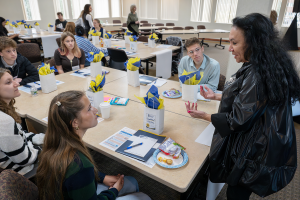
“Students joined us from all across the Capital Region, which was incredibly exciting,” said Kelly Masline, director of Capital Region BOCES Educational Support Services, which worked with state education and NYSSBA to offer the training. “We designed the training with the goal of having students walk away with the tools and confidence they need to speak up and truly represent their classmates this year.”
NYSSBA President Christine Schnars, said, “we’re excited to welcome the next generation of civic-minded leaders and to help them understand their roles and responsibilities. We thank all of these students for their dedication to community service and leadership.”
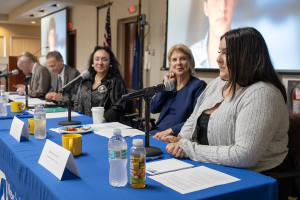
The training was held in celebration of student voice and to help prepare students for their role on their local Boards of Education as required by a 2025 law sponsored by state Sen. Shelley Mayer, who attended the event as a panelist alongside New York State Education Commissioner Betty A. Rosa, NYSSBA representatives Brian Fessler and Jay Worona, and former student ex officio Jahnyce Sotomayor from Schenectady.
Capital Region BOCES staff were also in attendance, including members of the Educational Support Services division, District Superintendent and Chief Executive Officer Lauren J. Gemmill and Assistant District Superintendent for Curriculum and Instruction Karen Swain.
“You [students] are here because of a bill that was proposed and passed by both houses of the legislature, signed by the governor and eventually became law and required— although before it was optional—every school board has a non-voting student member,” said Sen. Mayer.
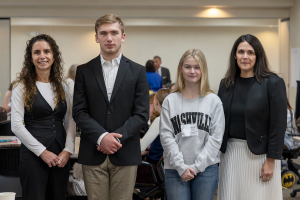
“I was convinced that the adults on our school boards were not always listening to the students, and the students on our school boards were not always having their voices heard,” she said. “ I encourage you, please use your voice. Try to represent as best as you can the interest of your fellow students.”
Capital Region BOCES student Board of Education member Robert Hudson from Niskayuna said there were a lot of great takeaways from the “very formal” training.
“It’s very nice for us students to have an opportunity to improve the governance of our schools, and for our [future] careers as well,” he said.
“I’ve met so many wonderful people and have been talking about subjects that I would not think I would even have a voice in. And it’s just amazing how I have such an impact in my local area,” said Hudson of his time on the board.
Luke Lippett, a National Student Board Member Association Representative, and Board of Regents Adrian I. Hale also joined virtually to deliver words of encouragement.
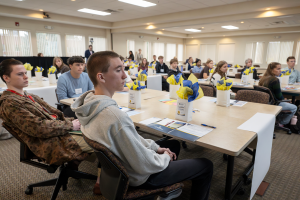
“I want you all to understand that as young people, you have the most important choice everyday that you sit at that desk next to your peers and there are real life circumstances and situations that you carry the intimate knowledge of that your classmates or schoolmates have with you,” said Regent Hale. “You can either be a change agent, or you can be a perpetuation of the past into the present by not speaking up, by not advocating, and by not making sure your voices are heard so that we can do our job of recreating this thing we call school.”
Other topics discussed at the training included methods for reaching a consensus on contentious issues and how students can work with board members who have different perspectives.
“My message to all of you is to use those amazing skills to really become agents of change, and the agent that sits on the board and comes back with evidence, with guiding questions, with ability to give voice to those who are dependent on you and have placed you in this amazing role that you know you’re going to turn into action,” said Commissioner Rosa. “All of those skills are the kind of skills that we want our students to walk away with as individuals that will participate in this democracy, in civic engagement, in civic readiness.”