
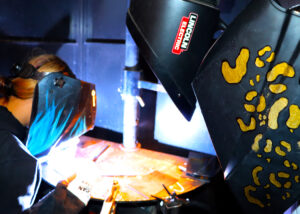
 Though women constitute between 5 and 6% of the welding industry workforce, an increasing number of young women are pursuing training for the industry at the Capital Region BOCES Career and Technical Education (CTE) Center.
Welding and Metal Fabrication seniors Nova Squires and Natalia Arnold are among approximately a dozen students enrolled in the program this year—a number that is about double what the program had just a few years ago.
“I have been around welding my entire life and I really enjoy it,” said Arnold, a Middleburgh student who was introduced to the trade by her family.
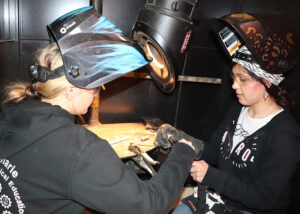 For Squires, the passion for welding developed from an interest in finding a trade she liked and the ability to make money while challenging gender stereotypes.
“Welding is a good career. You can make good money at it and I want to be rich, so there’s that,” the Cobleskill-Richmondville teen said. “I also think it can be very hard for women to get into the trades and I want to change that.”
Arnold said she wants more women to pursue careers under the welding hood.
“I feel that women need more representation in the industry. I want to be able to look back and say [Nova and I ] did it, we broke the cycle,” she said.
While there may just be a dozen or so women welders among about 100 students currently enrolled in the program at Capital Region BOCES, being a minority isn’t a problem for Arnold or Squires.
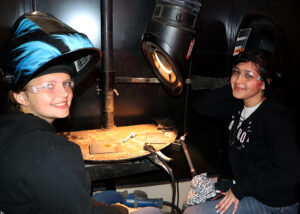 “These boys are great,” Squires said.
“You just have to show them you can do it, and they are great,” added Arnold.
Knowing how to weld can provide students with great career options.
Teacher Chris Johnson praised the scholars.
“Nova is building on all the skills she learned last year. She is working diligently to learn the new skills in TIG welding. Natalia got a later start in the program but is rapidly grasping the basics,” he said.
The American Welding Society forecasts a need for 320,500 new welding professionals by 2029. The society also reports an average national salary of about $50,000 a year.
Local woman welder Tori Rodriguez often shares her expertise with Capital Region BOCES students.
“Being in the trades, there is a stability that you can’t find in other industries. These aren’t jobs that a robot cannot do,” said Rodriguez, who is an entrepreneur and an Account Executive for Haun Welding Supply.
The Capital Region BOCES Welding and Metal Fabrication program prepares students with the skills they need to either directly enter the workforce or expand their skills in a college or trade school. During the two-year program that is taught on the Albany and Schoharie campuses, students learn American Welding Society standards and earn certifications that prepare them for a career in the welding industry.